
Well-known painter Amrut Patel has been on the national art scene for nearly four decades. His penchant for experimenting with visual imageries has earned him a distinctive place in the contemporary art world. Looking at his creative oeuvre one may marvel at the artist’s deep sense of yearning to fathom out newer formal entities and configurations that appear on his canvases. Aesthetic serenity of colours, tonal variations, and the delicately balanced forms often juxtaposed on one another, are the hallmarks of a large number of works done by the artist. His most recent non-narrative works, mostly done in acrylic on canvas or paper, resonate with a brooding silence that invites the viewer into the realm of the ‘virtual space’.
Born in a small village near Ahmedabad and product of Fine Art College, (Ahmedabad) Amrut Patel started his career way back in the late sixties. Ever since he has held several solo shows and participated in many group shows here and abroad. Apart from the several state awards that he has received so far he was also honoured with the National Award by Lalit Kala Akademi in 1976, He has remained associated with many major art events at the national and international levels. In 2004, he curated the prestigious exhibition of National and Triennale Awardees-‘Swarnarekha’- organized by Lalit Kala Akademi on the occasion of Golden Jubilee Celebrations.
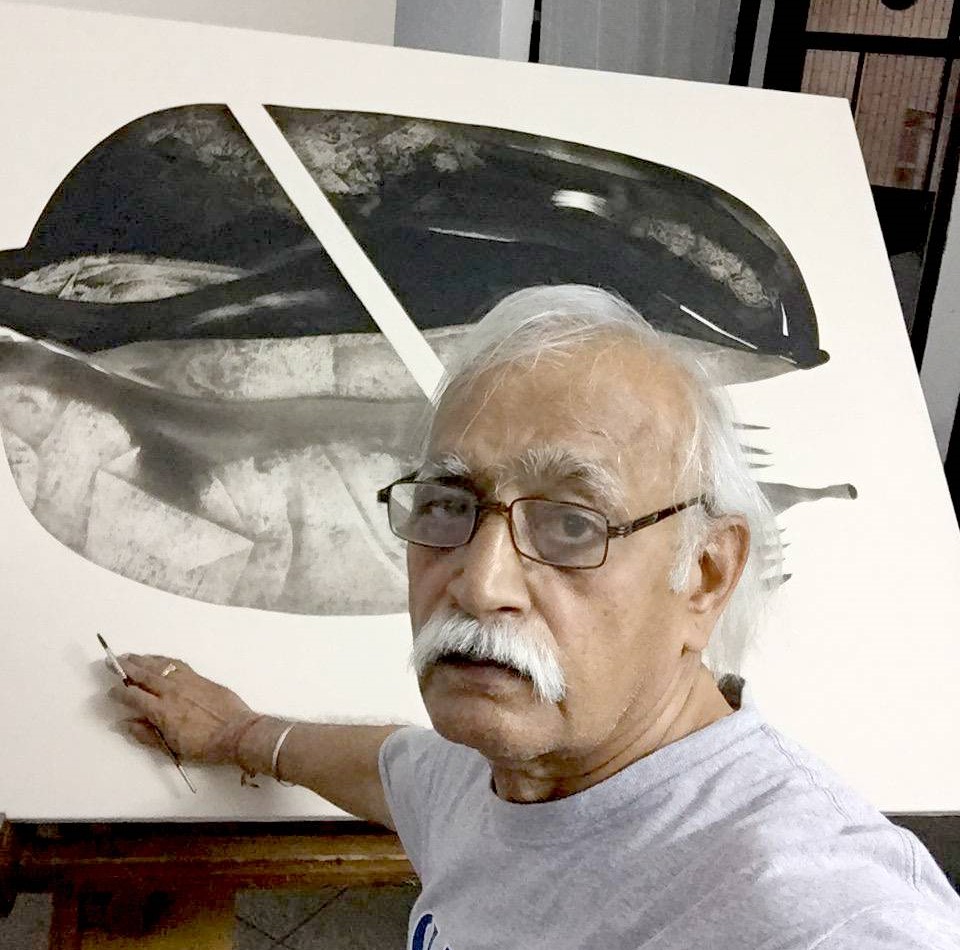
The artist seems to have developed a methodology in which he naturally surrenders his creative antenna to the internal promptings of an unknown source. There is almost an uncanny way of delving into the subterranean steam of his inner being. The forms that appear on the picture surface at first seem unfamiliar through given with a degree of finality that is almost irresistible. These unknown forms begin to grow on the viewer thereby inviting one to look about in the hope of discovering similar images in and around the surroundings. In more recent times, more than these visual forms on the canvas, the artist seems to be perennially interested in feeling out the vast and expansive space around. Often the makes these sculptural forms with just one or two broad strokes of his brush that bespeak of spontaneity and deftness of execution.
In the works of his slightly earlier period, the artist shows a proclivity for filling out the entire space with mostly round and rectilinear colour patches thereby focusing mainly on the total composition. He has an interesting way of building up the picture space by putting the sharply contoured colour patches against a thinly laid surface usually a tint of sap green or ochre. The tonal variations in the same colour patches create an illusion of three-dimensionality. Some of these works are faintly reminiscent of the collages of S. R. Bhushan done during a particular phase by this eminent artist. Tones of grey, green and ochre punctuated by a stray line or stroke of some darker shades of red or blue abound in these paintings. The semiotic elements used in these works seem to have been borrowed mostly from an aerial view of crowded cityscapes.